Rust and features discoverability #
I’ve been working on several projects lately and writing a bit about them on my blog – especially, specific technical problems. This very blog entry is on a different level though: it’s about our tooling in Rust.
See, most tools in Rust are wonderful:
rustc, the official compiler, is pretty easy to use and even though it’s an advanced piece of software, it’s pretty unlikely you’ll have to use it directly (unless you’re doing something very exotic, or working on it directly).cargo, by far the most appealing tool in the Rust ecosystem to me, is a Rust build system and package manager. It downloads and checks your projects’ dependencies, using https://crates.io as a default mirror for your crates (but you can use other mirrors if you want and are brave enough, even yours), (cross) compiles, runs library, binary and even documentation tests, etc.cargoalso comes with a plugin system, allowing people to write cargo subcommands that can be installed like withcargo install cargo-treeand run withcargo tree. Most common plugins are:bloat.watch.tree.clippy.fuzz.expand.outdated.- List here.
rustup, used to select, switch, install and update Rust compilers, toolchains, support cross-compilation and select targets, etc.- RLS.
- Plus some additional, non-local tools such as
- Rust Playground.
- crates.io, obviously.
- The excellent Rust documentation, giving you information and documentation about the standard library, the procedural macro, the allocation system, etc.
- The docs.rs documentation host, hosting ALL crates’ documentation for free, automatically and with fuzzy searching.
- And many others.
Clearly, you can see we have lots of wonderful tools made by talented people and you can clearly feel how easy it is to start writing a crate, test it and publish it along with its documentation. It feels seamless. The documentation is a very important thing in any tech ecosystem for several reasons. And this blog is going to be about doc tooling and some specific parts of Rust.
Documentation is key to achieve good quality… but not only#
Whatever the project you work on, you ~should~ must document your code. There are several situations – let’s call this the First Hypothesis:
If you write code that is intended to be released publicly, you must document every public symbols:
- Structs, enums and type aliases.
- Any public field.
- Constants.
- Functions and macros.
- Traits along with their associated types / constants and methods.
- Trait impls (think of how useful the documentation of an
impl Defaultcan be!). - Modules.
Now, if you are writing something that is private to a crate that you plan to release, think about people who will want to contribute to help you with the crate. They will have to get to read your code. They will have to go through the (sometimes painful) process of adapting to someone else’s way to write code. So do them a favor: document your code.
Finally, what about things you don’t plan to release? Like, for instance, a binary? The same rule actually applies: what happens if someone tries to contribute? What if you save the project aside for some weeks and get back to it afterwards?
Those three paragraphs just show you that the First
Hypothesis was wrong: there are not several situations.
Only one: as soon as you write code, whatever whom it’s aimed at,
just document it. You’ll be thanked and you might even thank
yourself in a near future for doing so. Documenting your code
enables you to run cargo doc --open and immediately
start exploring. Exploring is when you need to catch up
with a project’s ideas, concepts, or whenever you join a team as a
new job and need to get used to the codebase.
I want to share my experience here: most people are bad at this – it’s not necessarily their faults, don’t blame them. Most teams I worked in were under high pressure, with business deadlines to meet – I’ve been there and still am. This is more about a political discussion to have with “the ones who give you such deadlines” but really, developing a project doesn’t stop at writing code and testing. Onboarding and discoverability should be considered of a massive importance, because it helps preventing the project from burying itself and getting too bloated for newcomers or even long-running team members to understand the actual heck is happening there. When someone new joins your team, you should help them to get accustomed to the codebase… but you also have to work. They should have leads or hints to get their feet wet. Several solutions exist to document that in kind of standardized ways:
- Write a
README.mdin all the projects your team has. This should be mandatory. Describe what the project is about, how to build it as a developer, how to run it as a dev-ops. Describe the architecture, etc. - Write a
CONTRIBUTING.mdto help onboarding newcomers with your team guidelines, conventions, engineering processes, etc. - Be consistent: it’s not because a small project consists in
only a single shell script that you shouldn’t write a
README.md: write it! - Something that I love doing, especially at work: have some
kind of a cron / task that builds the documentation for all your
projects across the scope of your team… and have it host it all on
a server documented in the top-level
README.mdof your team. This is a real plus: people will just go to that documentation link to search for things “that have already been done by the team” instead of reinventing the wheels – trust me, even the ones who wrote the features might have forgotten writing them already.
We’re now reaching the point of this blog entry: documentation can (should?) be used to explore what a project is about, how to use it, what are the public variants and invariants, etc. But there is however a problem in the current Rust ecosystem, preventing us from completely have a comfortable exploration of a crate or set of crates. A very, very important kind of public symbol is missing from the list of documented Rust symbols. Do you think you can figure out which one?
The missing piece to exploring a crate#
Have you ever worked with a customized crate? If you don’t know what I’m referring to, I’m thinking about crates that can be configured with features. For instance, as a good example of this, I’ll talk about a crate of mine: splines. The crate has several features you can set to achieve different effects:
"serialization": this feature will turn on the serde serialization code (bothSerializeandDeserialize) for all the public types exposed by splines."impl-cgmath": turn this on to have some cgmath’s types be usable directly within splines by implementing the appropriate traits from splines."impl-nalgebra": same thing as"impl-cgmath"but for nalgebra."std": automatically enabled, you can disable it withdefault-features = falseor--no-default-features. When disabled, the code behaves compiled withno_std.
All of this is currently documented in the
README.md of the project and the top-level
documentation of the project (for instance,
splines-0.2.3 has this
paragraph about features and what they do).
We have two problems here:
- It’s hard for a newcomer to discover and
explore features of splines (or any crate
using features) because they’re not documented like a Rust symbol
is (a function, a type, etc.), while they truly
are recognized by
rustcandcargo! - We can “bypass” this problem by documenting and having a list of features like I do with splines, but that requires the project contributors to ensure to update the list whenever they add, remove or alter the features set.
You can see that the situation is not really comfortable. I looked into the list of PRs and issues about that topic on rust-lang/rfcs and didn’t find anything. So I might start to write some ideas here and maybe, depending on the feedback, write a new RFC to fix that problem.
Pre-RFC: documenting and exploring crate features#
In order to know what modification we can do without
introducing breaking changes, we need to have a look at how
features are defined. This is done in a Cargo.toml
manifest, such as (from splines):
[features]
default = ["std", "impl-cgmath"]
serialization = ["serde", "serde_derive"]
std = []
impl-cgmath = ["cgmath"]
impl-nalgebra = ["nalgebra"]
A feature is a key-value object where the key is the name of the feature and the value is a list of dependencies (crate names, crate cluster, a feature of another crate, etc. – more about that here).
We could document the features here. After all, that’s what
Haskell does with cabal and flags:
So why not simply do the exact same in Rust within a
Cargo.toml manifest? Like so:
[features]
default = ["std", "impl-cgmath"]

[features.serialization]
description = "Set to automatically derive Serialize and Deserialize from serde."
dependencies = ["serde", "serde_derive"]

[features.std]
description = "Compile with the standard library. Disable to compile with no_std."
dependencies = []

[features.impl-cgmath]
description = "Implement splines’ traits for some cgmath public types."
dependencies = ["cgmath"]

[features.impl-nalgebra]
description = "Implement splines’ traits for some nalgebra public types."
dependencies = ["nalgebra"]
In order to introduce this feature in a retro-compatible way, using the “old” syntax would just behave the same way but without a description, making them optional.
The whole purpose of this addition would be that the rustdoc
team could assume the existence of an optional
description field on features and present them when
browsing a crate’s documentation, enriching the exploration and
discovering experiences of developers. Instead of having to look
at both lib.rs and Cargo.toml to look
for features, one could just simply go on https://docs.rs, look for the crate
they want to get features information et voila!
Features consequences#
Some people might think of the consequences of
features. Those are, after all, used for conditional compilation.
What that means is that part of the code might be hidden from the
documentation if it’s feature-gated and that the feature wasn’t
set when generating the documentation. An example with splines here.
You can see a few implementors of the Interpolate
trait (some basic types and some from cgmath because the
"impl-cgmath" feature is enabled by default) but not
the potential ones for nalgebra, which is
somehow misleading – people don’t know they can actually use nalgebra with splines!
A workaround to this problem is to get a local copy of the documentation, generating it with the wished features. However, this will not fix the problem of the discoverability.
A solution to this could be to simply “ignore” the
features while generating the documentation – and only while
generating it but annotate the documented symbols with the
features. That would enable something like this
(generated with
cargo doc --open --no-default-features and retouched
to mock the idea up):
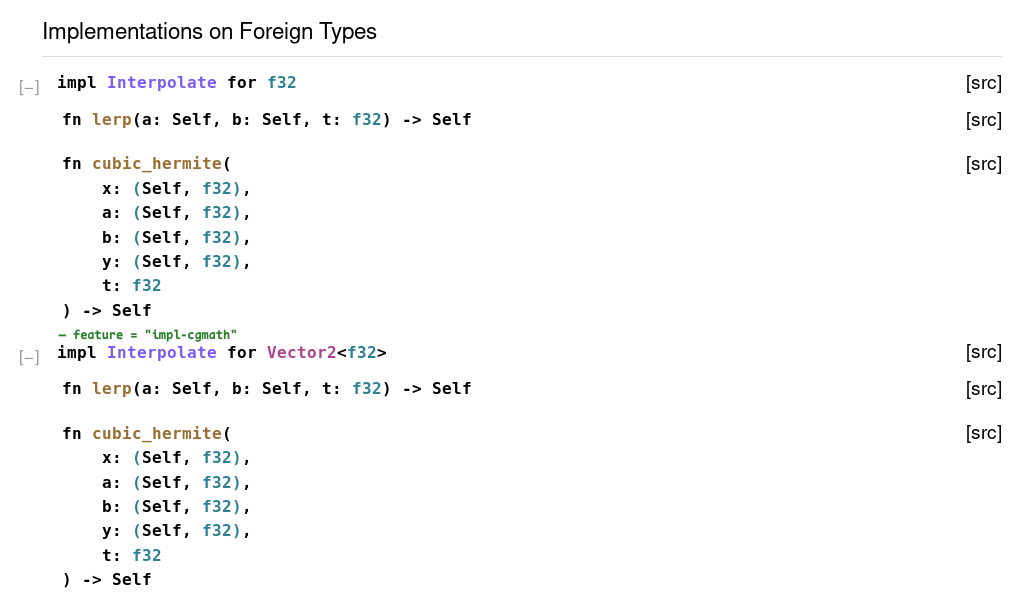
If several features are required, they would just be presented as a list above the annotated item.
That’s all for me today. Please provide your feedback about that idea. If you like it, I’ll write an RFC because I really think it’s a missing thing in the documentation world of Rust.
Keep the vibes!